


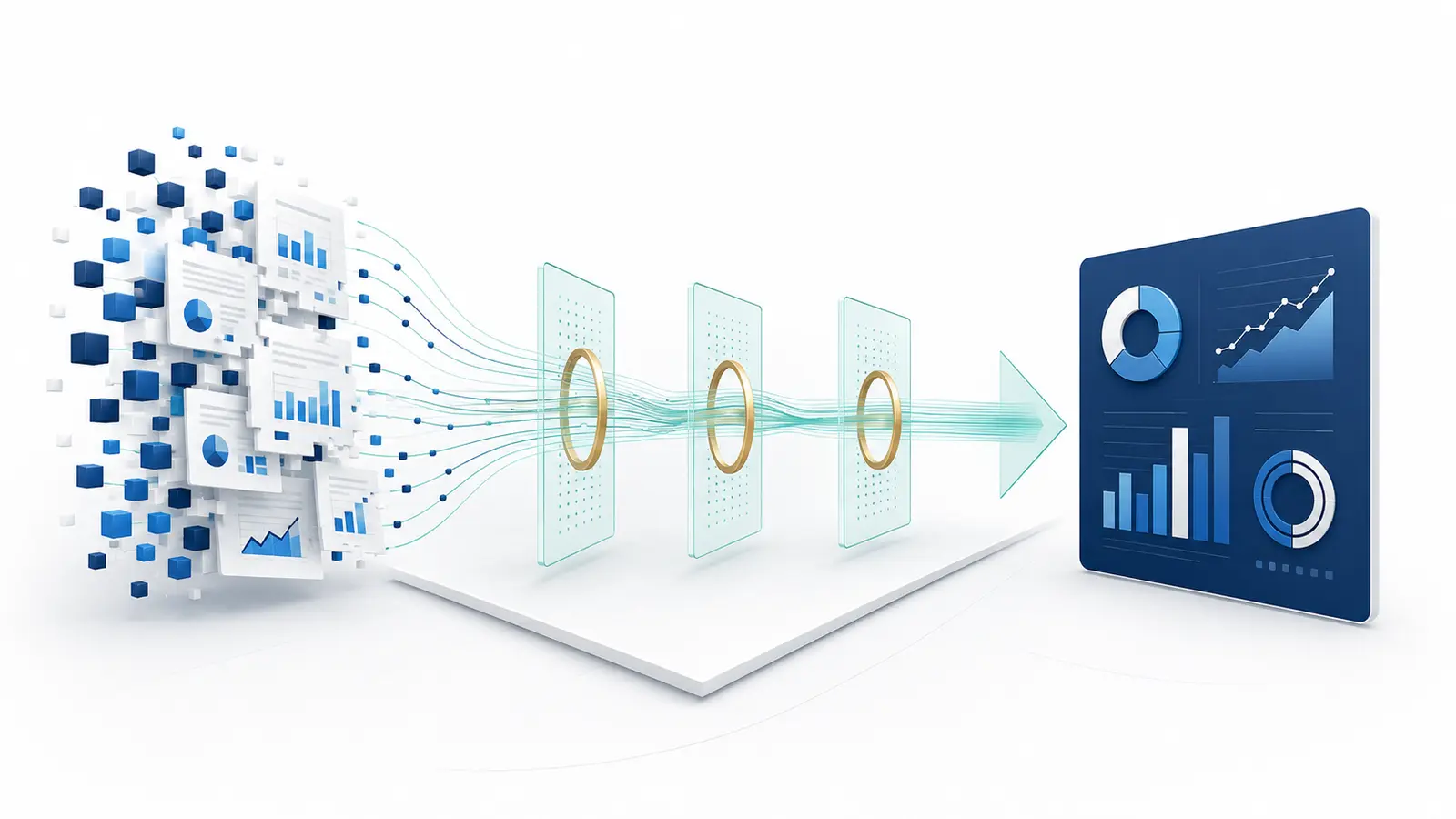
Financial Reporting Process Improvement: Create Faster, Trusted and Decision-Useful Reporting
When reporting depends on fragile spreadsheets, manual reconciliations and late explanations, finance spends its time assembling numbers instead of helping leadership act on them.
Finance performance must support the operating strategy
Financial reporting process improvement connects the close, consolidation, controls, data and management narrative. Optimising only the final report leaves the upstream causes of delay and error untouched.
The objective is not more reporting. It is a controlled flow of trusted information that meets statutory obligations and gives leaders an earlier view of performance, cash and risk.
What an effective engagement should address
The strongest programmes combine analysis, execution and governance. They improve the immediate output while building an operating discipline the internal team can sustain.
Close discipline
Create a sequenced calendar, materiality, cut-off rules, dependencies and visible sign-off.
Balance-sheet control
Standardise reconciliations, ageing, review evidence and resolution of open items.
Consolidation
Control mappings, eliminations, foreign currency, entity submissions and top-side entries.
Management reporting
Focus the pack on drivers, exceptions, outlook, decisions and accountable actions.
Data & automation
Remove duplicate handling, standardise definitions and automate stable, rules-based work.
Governance
Assign process owners, measure quality and maintain disciplined change control.
Illustrative reporting-cycle improvement
Cycle-time improvement should come from removing waiting, rework and unnecessary hand-offs—not from reducing essential review or tolerating unsupported balances.
Illustrative only, not a performance guarantee. The right target depends on complexity, systems, source-data timing and required controls.
Diagnose the complete reporting process
A useful diagnostic follows information from source system to executive decision. It distinguishes processing time from waiting time, rework and review constraints.
| Failure point | Typical symptom | Improvement response |
|---|---|---|
| Source data | Late or inconsistent submissions | Set ownership, cut-off, validation and escalation at source. |
| Accounting | Recurring manual journals and unexplained adjustments | Standardise rules, automate repeatable entries and analyse root causes. |
| Reconciliations | Stale items and weak evidence | Risk-rank accounts, define standards and track resolution ageing. |
| Consolidation | Mapping errors and spreadsheet dependence | Control master data, submissions, eliminations and review. |
| Management pack | Too many pages and too little explanation | Build a KPI hierarchy with variance bridges, outlook and actions. |
“Reporting is efficient when the right information reaches the right decision-maker with enough time, evidence and context to act.”
The CFO HQ perspective
From diagnosis to sustained performance
Improvement should be sequenced around business risk, value, capacity and change readiness—with a named owner and measurable outcome for every action.
Map
Document activities, owners, hand-offs, systems, controls, pain points and elapsed time.
Simplify
Remove duplicate work, standardise inputs and clarify materiality and review requirements.
Control
Embed reconciliation standards, approvals, evidence and transparent exception management.
Automate
Apply technology to stable processes and measure whether speed and quality improve.
Where organisations lose value
Most programmes do not fail because leaders misunderstand the headline objective. They fail where ownership, sequencing, evidence and day-to-day operating behaviour remain unresolved.
Redesigning only the final pack
The delay usually originates upstream in source data, accounting, reconciliations and review. Presentation changes alone do not correct the reporting chain.
Removing review to gain speed
A faster timetable achieved by weakening evidence or challenge increases the probability of late correction and loss of trust.
Automating before standardising
Rules-based technology requires stable definitions and ownership. Otherwise, exceptions multiply and spreadsheets return.
Measuring days but not quality
Cycle time must be considered alongside adjustments, reconciliation status, recurring issues and decision usefulness.
When external support adds value
External support can accelerate improvement where reporting is lender- or board-sensitive, the close depends on key individuals, a new consolidation or ERP platform is being introduced, or the team lacks transformation capacity. A focused diagnostic should leave the organisation with both immediate gains and a prioritised roadmap.
Measure quality as rigorously as speed
A shorter reporting timetable is valuable only when accuracy, control and insight are protected. Leadership should monitor late adjustments, reconciliation quality, recurring exceptions, forecast accuracy and the time spent producing versus analysing results.
Technology can improve workflow, consolidation and presentation, but it should follow process clarity. Automating a poorly defined process makes the same weaknesses operate faster and at greater scale.
Executive measures
A concise scorecard should show the outcome, underlying driver, trend, threshold and accountable action.
- Reporting cycle: Elapsed days and waiting time by stage.
- Late adjustments: Frequency, value, root cause and recurrence.
- Reconciliation health: Completion, review and ageing of open items.
- Insight capacity: Time spent analysing versus assembling data.
Charts and examples are illustrative. The appropriate targets, scope and timetable should be established following an assessment of the organisation’s strategy, systems, data, controls and operating complexity.